Babbel Review (2026): Is It Worth It for Beginners?
Last updated: July 2026
Reading time: 18 – 22 minutes
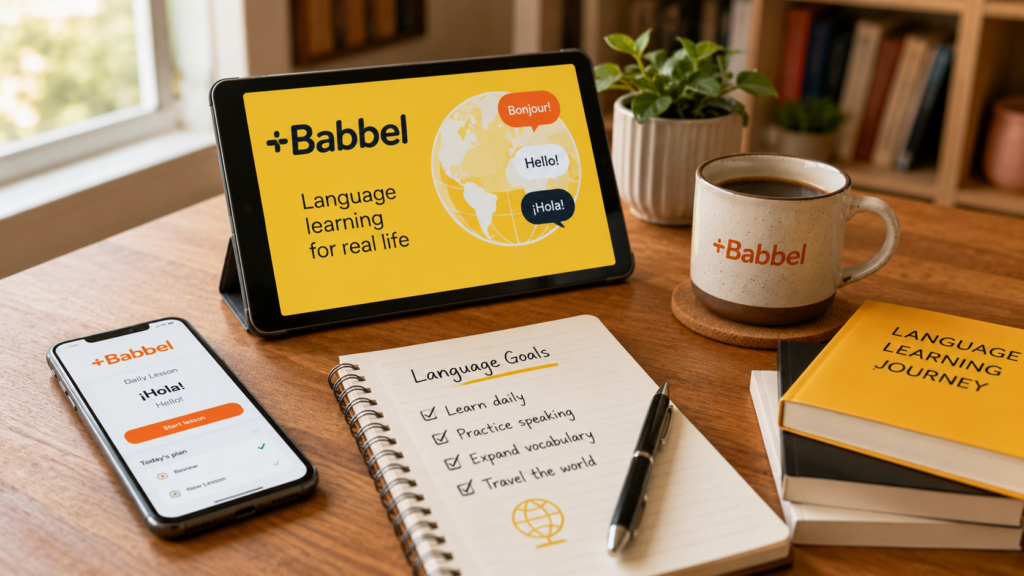
Learn Practical Conversation Skills with Short, Structured Lessons
Learning a new language can open the door to better travel experiences, professional opportunities, cultural connections, and personal growth.
However, choosing the right language learning platform is not always easy.
Some apps focus primarily on games and vocabulary. Others provide long, detailed courses that require a significant time commitment. For many beginners, the ideal solution is somewhere in between: structured enough to create real progress, but flexible enough to fit into everyday life.
Babbel is designed around that balance.
Its short, guided lessons combine practical vocabulary, grammar, listening, pronunciation, and real-world dialogue in a format created especially for adult learners.
In this Babbel review, we will examine how the platform works, its most important features, its strengths and limitations, who it is best suited for, and how it compares with Rocket Languages.
By the end, you should have a clearer understanding of whether Babbel matches your learning goals, schedule, and preferred study style.
Affiliate Disclosure
This page may contain affiliate links. If you purchase through one of these links, we may earn a commission at no additional cost to you.
Our recommendations are based on the learning experience, course structure, features, beginner friendliness, and overall value offered by each platform.
Quick Recommendation
Babbel is one of the strongest language learning options for adults who want practical conversation skills without committing to long study sessions.
Its structured courses, short lessons, clear grammar guidance, realistic dialogues, and vocabulary review tools make it particularly suitable for beginners and returning learners.
Babbel Is Best For:
- Adults learning a language for travel, work, or everyday communication
- Beginners who prefer short, guided lessons
- Busy learners who can study for only a few minutes each day
- Students who appreciate grammar explanations in context
- Learners who want practical vocabulary rather than random word lists
- People who prefer a clean, professional learning experience
Babbel May Not Be Ideal For:
- Learners who want a completely free course
- Students looking for long, highly immersive audio lessons
- People who prefer strongly gamified apps
- Advanced learners seeking extensive academic content
- Learners who want live conversation practice included as the central part of every lesson
Our overall assessment: Babbel is an excellent choice for beginners who value simplicity, structure, practical communication, and consistent daily progress.
Why Trust Smart Learning Reviews?
At Smart Learning Reviews, our goal is to help learners make informed decisions before investing their time and money in a language learning platform.
We evaluate courses according to the factors that matter most to beginners:
- Learning methodology
- Lesson quality
- Ease of use
- Grammar support
- Speaking and pronunciation practice
- Beginner progression
- Study flexibility
- Long-term learning potential
- Overall value
We do not believe that one platform is perfect for everyone.
The best language learning app is the one that matches your goals, preferred learning style, available study time, and level of commitment.
What Is Babbel?
Babbel is an online language learning platform designed to help adults develop practical communication skills through structured, interactive lessons.
Rather than presenting learners with disconnected vocabulary exercises, Babbel organizes its courses around useful situations, everyday expressions, grammar in context, listening activities, and realistic conversations.
For English-speaking learners, Babbel currently offers courses in 13 languages:
- Spanish
- French
- German
- Italian
- Portuguese
- Dutch
- Swedish
- Norwegian
- Danish
- Polish
- Turkish
- Indonesian
- Russian
Course availability, content depth, and proficiency levels may vary depending on the language selected.
Babbel can be accessed through its website or mobile application. Progress is synchronized across compatible devices, allowing learners to begin a lesson on one device and continue on another.
The mobile app also supports downloadable lessons, making it possible to continue studying without an active internet connection.
How Does Babbel Work?
Babbel follows a guided course structure that gradually introduces vocabulary, grammar, listening, speaking, reading, and writing skills.
New learners begin by selecting the language they want to study and answering a few questions about their experience, motivation, and goals.
The platform then recommends a learning path appropriate to their current level.
Most lessons are designed to be completed in approximately 10 to 15 minutes. This makes Babbel easier to incorporate into a daily routine than courses that require long study sessions.
A typical lesson may include:
- New vocabulary and expressions
- Short dialogues
- Listening exercises
- Sentence-building activities
- Grammar explanations
- Pronunciation practice
- Writing exercises
- Vocabulary review
The material is introduced gradually, with new concepts building on what the learner has already studied.
This structured progression is one of Babbel’s most important advantages for beginners. Instead of deciding what to study next, learners can follow a clear path from basic expressions toward more complex communication.
Who Is Babbel Best For?
Babbel is especially well suited to adults who want to develop useful language skills through a flexible but organized program.
Complete Beginners
Starting a new language can feel overwhelming, especially when an app introduces too much vocabulary without explaining how the language works.
Babbel gives beginners a clearer sense of direction by presenting lessons in a logical sequence. Vocabulary, grammar, pronunciation, and dialogue are introduced in manageable steps.
This can help learners build confidence without feeling overloaded.
Busy Adults
The short lesson format works well for people balancing work, family responsibilities, travel, or other commitments.
A learner can complete a lesson during a commute, lunch break, or quiet period at home without needing to reserve an entire hour for study.
Travelers
Many Babbel lessons focus on situations learners may encounter while traveling, such as introducing themselves, ordering food, asking questions, navigating transportation, and handling everyday conversations.
This makes the platform useful for learners preparing for a trip or planning to spend time abroad.
Professionals
Babbel may also appeal to professionals who want to improve practical communication skills for work, relocation, or interaction with international colleagues.
The platform’s structured and professional design can feel more suitable for adult learners than highly gamified alternatives.
Returning Learners
People who previously studied a language but have forgotten vocabulary or grammar may use Babbel to rebuild their foundation.
Learners can explore different courses and repeat lessons when necessary rather than being restricted to a single rigid path.
Main Features
Babbel combines several learning tools to create a balanced experience for beginners and intermediate learners.
1. Short, Structured Lessons
Most Babbel lessons take approximately 10 to 15 minutes to complete.
The short format makes it easier to study consistently, while the structured course path prevents the learning experience from becoming random or directionless.
Each lesson introduces a manageable amount of material and reinforces it through different types of exercises.
2. Real-Life Conversations
Babbel places strong emphasis on language that learners may actually use.
Instead of focusing only on isolated words, lessons frequently introduce vocabulary through dialogues and practical situations.
This helps learners understand not only what a word means, but also how it functions naturally within a sentence or conversation.
3. Grammar in Context
Grammar is often one of the most intimidating parts of learning a language.
Babbel explains grammar gradually and connects it to the expressions being studied. Learners are not expected to memorize long technical rules before using the language.
This approach can make grammar more accessible, particularly for adult beginners who want to understand why a sentence is structured in a particular way.
4. Speech Recognition
Babbel includes speaking exercises that allow learners to listen to a word or phrase, repeat it, and receive pronunciation feedback.
This feature is useful for developing awareness of unfamiliar sounds and building confidence before attempting real conversations.
Speech recognition should not replace interaction with native speakers, but it can provide valuable guided practice during the early stages of learning.
5. Vocabulary Review
New words and phrases from completed lessons are added to Babbel’s review system.
The platform uses spaced repetition, meaning that vocabulary is scheduled for review according to the learner’s previous performance.
Words that are remembered correctly appear less frequently over time, while difficult words return more often.
This helps learners move vocabulary from short-term recognition toward longer-term memory.
6. Native-Speaker Audio
Babbel lessons use recorded audio to help learners become familiar with natural pronunciation, rhythm, and intonation.
Hearing words and phrases spoken clearly is important for both listening comprehension and pronunciation development.
7. Offline Learning
Full lessons can be downloaded through the Babbel mobile app.
This allows learners to continue studying while traveling, commuting, or spending time in places without reliable internet access.
Downloaded vocabulary review activities and selected podcasts may also be available offline.
8. Cross-Device Progress
Learners can access Babbel through a compatible web browser, smartphone, or tablet.
Progress synchronizes across devices, allowing users to continue from where they stopped.
This flexibility is particularly valuable for people who divide their study time between home, work, and travel.
9. Additional Learning Resources
Depending on the language being studied, Babbel may provide supplementary resources such as:
- Grammar guides
- Podcasts
- Cultural lessons
- Travel-related content
- Business vocabulary
- Pronunciation practice
- Themed courses
The availability and depth of these resources can vary by language.
The Babbel Learning Experience
Babbel’s strongest quality is not a single feature. It is the way the platform combines simplicity with structure.
The interface is clean, lessons are easy to navigate, and learners generally understand what they are expected to do next.
Exercises change throughout each lesson, helping prevent the experience from becoming repetitive. A learner may listen to a dialogue, complete a sentence, repeat a phrase, match vocabulary, and review grammar within the same session.
The tone feels more like a guided adult course than a game.
This makes Babbel attractive to learners who want a serious learning experience without the intensity of a traditional classroom or a long-form course.
However, the short lesson format also creates limitations.
Babbel can introduce practical language effectively, but learners who want extensive listening practice, long interactive conversations, or deeper cultural instruction may need additional resources.
The platform works best as a consistent foundation rather than as the only source of language exposure.
Is Babbel Easy to Use?
Babbel is generally beginner-friendly.
The platform guides learners through a clear sequence, and the exercises are presented in a straightforward way. Navigation does not require advanced technical knowledge, and lessons can be accessed through both mobile devices and a web browser.
The app is particularly convenient for learners who prefer studying in short sessions.
Because progress is saved automatically and synchronized across compatible devices, users do not need to remember where they stopped.
Beginners may occasionally find pronunciation exercises or grammar concepts challenging, but this is part of the learning process rather than a problem with the interface.
Overall, Babbel offers one of the cleaner and more accessible experiences among premium language learning platforms.
Babbel Pros and Cons
Pros
✔ Short lessons that fit easily into a daily routine
✔ Structured learning path for beginners
✔ Practical vocabulary and real-life conversations
✔ Grammar explanations presented in context
✔ High-quality native-speaker audio
✔ Speech recognition for pronunciation practice
✔ Spaced-repetition vocabulary review
✔ Offline lessons through the mobile app
✔ Progress synchronization across devices
✔ Professional interface designed for adult learners
Cons
✘ Full course access requires a paid subscription
✘ Language selection is smaller than some major competitors
✘ Course depth can vary depending on the language
✘ Speaking exercises do not replace real conversations
✘ Less immersive than longer audio-based programs
✘ Learners seeking advanced mastery may need additional resources
✘ The experience may feel less motivating to people who prefer games and rewards
Babbel Pricing and Subscription Options
Babbel operates primarily through a paid subscription model.
Subscription options may vary depending on the learner’s location, the purchasing platform, current promotions, and the length of the plan selected. Longer subscriptions generally offer a lower monthly equivalent than shorter plans.
However, learners should understand that Babbel normally charges the full subscription period in advance. Most renewable subscriptions also renew automatically unless they are canceled before the next billing date.
Depending on availability, Babbel may offer:
- Short-term subscription plans
- Six-month or annual plans
- Access to a single language or multiple languages
- Lifetime access offers
Babbel also allows new users to register for free and try the first lesson of each course before purchasing full access.
Because prices and promotions can change by country and purchasing method, learners should check the current offer directly on Babbel before subscribing.
Pricing verdict: Babbel may provide good value for learners who plan to study consistently. Short lessons make the platform easy to use regularly, but a subscription will offer limited value if the learner studies only occasionally.
Is Babbel Good for Complete Beginners?
Yes. Babbel is one of the most accessible premium language learning platforms for complete beginners.
Its lessons begin with fundamental words and expressions before progressing toward more complex sentence structures and conversations.
The platform provides enough guidance to reduce the confusion many learners experience when studying independently.
Beginners benefit from:
- A clear learning sequence
- Manageable lesson length
- Grammar guidance
- Repetition of important vocabulary
- Native-speaker audio
- Speaking exercises
- Practical conversational situations
Babbel is particularly effective for beginners who prefer understanding how the language works rather than memorizing words without context.
However, no app can guarantee fluency on its own.
To achieve strong conversational ability, learners should eventually combine Babbel with additional listening, reading, writing, and real-world speaking practice.
Can Babbel Help You Speak Confidently?
Babbel can help learners build the vocabulary, pronunciation awareness, sentence patterns, and listening skills needed for conversation.
Its dialogues introduce practical phrases, while speech-recognition exercises encourage learners to speak aloud rather than studying silently.
This is valuable preparation for real-world communication.
However, speaking confidently requires interaction.
An app can help learners rehearse language, but it cannot fully reproduce the unpredictability, speed, and emotional pressure of a live conversation.
For stronger results, Babbel should be combined with activities such as:
- Speaking with a language partner
- Practicing with a tutor
- Repeating native-speaker audio aloud
- Listening to podcasts or videos
- Recording and reviewing your own speech
- Using the language during travel or everyday situations
Babbel provides a strong foundation, but active communication is what transforms learned material into usable speaking ability.
Babbel vs Free Language Apps
Free language apps can be excellent for beginning a new language, building a daily habit, and learning basic vocabulary.
They are particularly useful for learners who are not yet ready to pay for a structured course.
However, free platforms often rely heavily on repetition, gamification, and short exercises. Grammar explanations, practical dialogue, course organization, and speaking development may be more limited.
Babbel offers a more guided experience.
Its greatest advantages over many free apps include:
- More deliberate course progression
- Clearer grammar explanations
- Practical dialogue
- Professional lesson design
- Structured vocabulary review
- An ad-free learning environment
A free app may be enough for casual practice or testing your interest in a language.
Babbel is more appropriate for learners who are ready to follow a structured path and develop practical communication skills consistently.
Babbel vs Rocket Languages
Babbel and Rocket Languages are both designed to help adults develop practical language skills, but they approach the learning process differently.
The best choice depends on how much depth, structure, flexibility, and study time you want from your course.
Learning Experience
Babbel is built around short, focused lessons that can be completed in approximately 10 to 15 minutes.
The platform introduces practical vocabulary, grammar, listening, pronunciation, and dialogue in small, manageable steps.
Its learning experience is efficient, polished, and easy to incorporate into a busy routine.
Rocket Languages takes a more comprehensive approach.
Its courses place greater emphasis on extended audio lessons, interactive conversations, detailed explanations, pronunciation practice, cultural context, and a broader range of reinforcement activities.
Rocket Languages often feels closer to a complete self-study course, while Babbel feels like a streamlined and highly structured learning app.
Lesson Depth
Babbel prioritizes clarity and efficiency.
Lessons are designed to help learners understand and use practical language without requiring long study sessions. Grammar is introduced in context, and activities move at a pace that feels manageable for beginners.
Rocket Languages generally explores each topic in greater depth.
Its longer lessons provide more space for listening, repetition, conversation analysis, pronunciation, and cultural explanation.
This depth can be valuable for learners who want a more immersive course, but it also requires a greater time commitment.
Speaking and Listening Practice
Babel includes native-speaker audio, realistic dialogue, and speech-recognition activities.
These tools help learners develop pronunciation awareness and become comfortable repeating useful phrases.
Rocket Languages places even greater emphasis on audio-based learning.
Its interactive audio lessons are designed to guide learners through conversations and encourage them to respond aloud throughout the lesson.
Learners who prioritize extended listening and speaking practice may find Rocket Languages more comprehensive.
Grammar and Explanations
Both platforms provide grammar support, but the presentation differs.
Babbel explains grammar briefly and in context. This keeps lessons moving and prevents beginners from feeling overwhelmed.
Rocket Languages tends to provide more detailed explanations and additional examples.
Babbel may be more comfortable for learners who want grammar introduced gradually. Rocket Languages may appeal more to learners who want to understand language patterns in greater depth.
Study Flexibility
Babbel is particularly convenient for busy learners.
Its compact lessons make it easy to maintain a daily routine, even when study time is limited.
Rocket Languages is also self-paced, but learners may need longer sessions to benefit fully from its audio lessons and detailed course material.
Learning Commitment
Babbel works well for learners who want steady, practical progress without turning language study into a major daily commitment.
Rocket Languages is better suited to people willing to invest more time in a comprehensive learning process.
Neither approach is automatically better.
The stronger choice is the one that matches the learner’s schedule, goals, and preferred level of depth.
Choose Babbel If You:
- Prefer lessons that take approximately 10 to 15 minutes
- Want practical language for travel, work, or everyday situations
- Like clean, guided, app-based learning
- Need a course that fits into a busy schedule
- Prefer grammar explained briefly and in context
- Want to build a consistent daily study habit
Choose Rocket Languages If You:
- Want a more comprehensive self-study course
- Prefer longer audio lessons
- Want deeper speaking and listening practice
- Appreciate detailed explanations and cultural context
- Can dedicate more time to each study session
- Are pursuing stronger long-term language development
Our Verdict
Babbel and Rocket Languages serve different learner profiles.
Babbel stands out for accessibility, efficiency, and practical conversation. It is especially effective for busy adults and beginners who want structured progress through short daily lessons.
Rocket Languages stands out for depth, audio instruction, and comprehensive course structure. It may provide stronger long-term value for learners willing to spend more time developing listening, speaking, grammar, and cultural understanding.
For short, consistent, conversation-focused study, Babbel is the better fit.
For learners seeking a deeper and more complete language education, Rocket Languages has the advantage.
Want a More Detailed Comparison?
Choosing between Babbel and Rocket Languages involves more than comparing lesson length.
Their teaching methods, speaking activities, course depth, flexibility, and ideal user profiles can lead to very different learning experiences.
Read our complete side-by-side comparison before choosing your platform.
Is Babbel Worth It in 2026?
Babbel may be worth considering if you want a professionally designed language course that is structured, practical, and easy to fit into your schedule.
Its strongest value comes from the combination of:
- Short, organized lessons
- Practical conversation
- Clear grammar guidance
- Native-speaker audio
- Pronunciation exercises
- Vocabulary review
- Offline access
- Cross-device flexibility
Babbel is more substantial than a basic vocabulary app but less demanding than many comprehensive courses.
That middle ground is exactly what makes it appealing to adult beginners.
Its value will depend on how consistently you use it. A well-designed platform cannot create progress without regular practice.
Learners who complete lessons consistently, review vocabulary, speak aloud, and use additional language resources are likely to gain more from Babbel than people who open the app only occasionally.
Final Verdict
Babbel remains one of the strongest language learning platforms for adults and beginners in 2026.
Its greatest advantage is balance.
The platform provides more structure, grammar guidance, and practical communication than many casual learning apps, while remaining more accessible and flexible than long-form language courses.
Babbel is particularly well suited to:
- Complete beginners
- Busy adults
- Travelers
- Professionals
- Returning learners
- People who prefer short, guided study sessions
Its lessons are clear, practical, and easy to follow. The combination of dialogue, grammar, pronunciation, native-speaker audio, and vocabulary review creates a strong foundation for continued learning.
Babbel is not a complete replacement for real conversation, extensive listening, or immersion. Advanced learners may eventually need more specialized material.
However, for beginners who want to build practical language skills without feeling overwhelmed, Babbel is an excellent place to start.
Our recommendation: Choose Babbel if your priority is developing useful everyday communication through short, structured, and consistent lessons.
Continue Exploring Language Learning Guides
Choosing a language learning platform is easier when you compare different teaching methods, course structures, and learner profiles.
Continue your research with our related reviews and guides.
Babbel vs Rocket Languages
Compare both platforms side by side and discover which learning experience better matches your goals.
Best Language Learning Apps for Beginners
Compare Babbel, Rocket Languages, Duolingo, Busuu, and Mondly in our complete beginner’s guide.
Rocket Languages Review
Explore the features, strengths, limitations, and learning experience offered by Rocket Languages.
Language Learning Hub
Browse our latest reviews, comparisons, recommendations, and beginner-friendly language learning resources.
Ready to Start Learning with Babbel?
Babbel combines practical conversations, short lessons, grammar guidance, pronunciation practice, and vocabulary review in a format designed for busy adult learners.
Explore the platform and decide whether its learning method matches your goals.
Frequently Asked Questions
Is Babbel good for complete beginners?
Yes. Babbel provides structured courses that begin with basic vocabulary, expressions, pronunciation, and sentence patterns. Its short lessons and clear progression make it accessible to people studying a language for the first time.
How long are Babbel lessons?
Most Babbel lessons are designed to take approximately 10 to 15 minutes. The exact time may vary depending on the lesson, learner, and number of exercises repeated.
Does Babbel teach grammar?
Yes. Babbel introduces grammar within practical examples and conversations. Explanations are generally concise and connected to the language being used in the lesson.
Does Babbel include speaking practice?
Babbel includes speaking exercises, native-speaker audio, and speech-recognition technology. These features can help learners improve pronunciation awareness, but they should eventually be combined with real conversation practice.
Can Babbel be used offline?
Yes. Full lessons can be downloaded through the mobile app for offline study. Vocabulary review and selected additional resources may also be available without an internet connection.
Can I use Babbel on more than one device?
Yes. Learners can access their accounts through compatible mobile devices and web browsers. Progress synchronizes across devices when the account reconnects to the internet.
Is Babbel better than Duolingo?
Babbel generally offers a more structured, grammar-supported, and conversation-focused experience. Duolingo places greater emphasis on gamification, motivation, and free daily practice.
Babbel may be better for learners who want a guided premium course. Duolingo may be better for casual learners who prioritize a free and game-like experience.
Is Babbel better than Rocket Languages?
Babbel is better suited to learners who prefer short, practical lessons and a flexible daily routine.
Rocket Languages may be better for learners who want longer audio lessons, greater depth, cultural explanations, and a more comprehensive self-study course.
Can Babbel make you fluent?
Babbel can help learners build vocabulary, grammar, listening, pronunciation, and practical communication skills.
However, fluency normally requires additional exposure through real conversations, reading, listening, writing, and consistent use of the language outside the app.
Is Babbel worth paying for?
Babbel may be worth paying for if you value structured lessons, practical conversations, grammar guidance, an ad-free experience, and a clear learning path.
Its value depends largely on whether the platform’s short-lesson format matches your learning style and whether you use it consistently.
At Smart Learning Reviews, we help learners compare language platforms with clarity and confidence.
Explore our honest reviews, practical comparisons, and beginner-friendly guides to find the learning method that best matches your goals.
Learn smarter. Choose with confidence.